Adding voltage for LED Strip Lights

How To Fix The Voltage Drop Issue For LED Strips?

When you connect multiple 5-meter light strips in series, you will find that the LEDs closer to the power source are brighter than those farther away. This is a voltage drop issue that causes inconsistent brightness. Today, we will check how to solve this issue.

LED Strips Voltage Drop

What Is Voltage Drop?

When the light strip is connected in series for more than 10 meters, the voltage will decrease when the current passes through many electronic components: LEDs and resistors. For example, if the normal working voltage is 24V, the measured voltage may be only 20V at 15 meters. If the working voltage of the LED is lower than the standard working voltage, it will appear darker to the naked eye compared to the LED closer to the voltage. This is called voltage drop.

How To Solve?

There are three solutions to solve the voltage drop issue.

  1. Connect the LED Strips in parallel.

If you are installing multiple light strips for your project and need them to be uniformly bright, we would recommend connecting them in parallel to a power supply or controller so that all LEDs have the same operating voltage.

Connect LED Strip In Parallel

2. Choose the high-voltage LED Strips

Because the high-voltage light strips have a parallel design of the lamp beads on the circuit, the voltage drop is very unobvious even in long-distance projects, so they are very suitable for outdoor long-distance projects. The maximum lengths can be 50 meters or 100 meters per roll, and they can be connected in series.

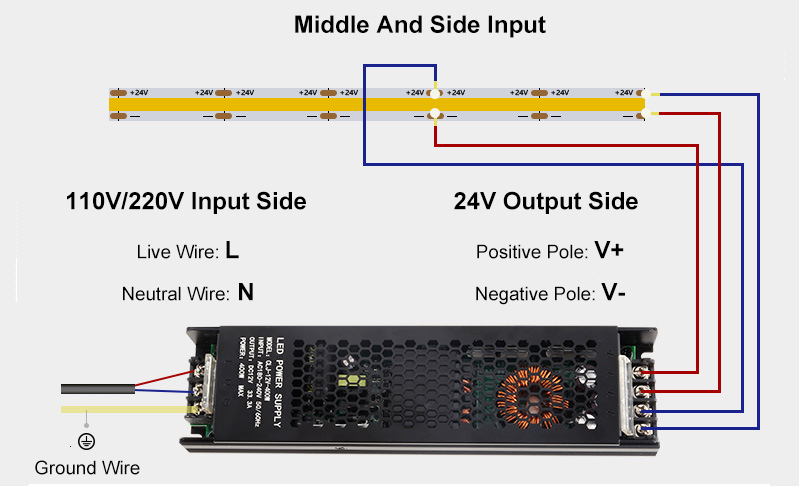
3. Add voltage From the Middle Or Other End

The third solution to fix the voltage drop issue is to add the same voltage from the middle or the other end if the length of the parallel light strip exceeds 10 meters or 15 meters. It is suitable for indoor and outdoor voltage light strip projects. Below is a picture of the wiring diagram for all kinds of connections.

How-To-Fix-Voltage-Drop-Issue

Conclusion

For most users, the method of adding voltage is easiest. No matter how long the light strips are, if you find that the brightness of the LEDs is inconsistent, especially for the high-density COB or SMD LED strips, you can solve this problem by adding the voltage from the middle or the end as shown in our picture.

How To Solve The Voltage Drop Issue For Flexible LED Strips?

The voltage drop is a common issue; the main reason for the problem is that the Flexible LED Strips run longer runs than 10 meters or 15 meters; the length depends on the quantity of the parts on the LED Strips, which will result in LEDs further from the power source appearing dimmer than those close to it. Today, let’s check how to solve it.

In DC circuits, the voltage gradually drops when it travels along through the LED Strip lights. Many parts, such as LEDs, resistors, and copper PCB boards, will reduce the voltage. The LEDs that are farther away from the power supply will not get enough voltage, which will cause weak brightness. The whole LED Strips look un-uniform lighting.

So, how do we solve the voltage drop issue? There are two solutions to solve the problem.

  1. Connect the Flexible LED Strips to the Controller or Power Supply in parallel with wires, which shortens the distance between the LEDs and the power source. The LEDs on the far ends will get as much voltage without much loss.
  2. Add the same voltage on the middle or the other end.

By following these solutions, you can significantly reduce the voltage drop and ensure that the Strip lights maintain consistent brightness across their entire length to get uniform lighting.